

Berta Hummel Christmas ornaments are small porcelain ornaments made by Goebel between 1997 and 2004 under the name “A Berta Hummel Christmas,” each one showing a child in a seasonal scene drawn from the early artwork of Berta Hummel. They were sold in numbered boxed sets of three, each ornament accompanied by its own certificate of authenticity, and because the line was discontinued more than twenty years ago, every piece available today comes from the secondary market.
That combination — a fixed number of designs, a clear numbering system, and pieces that were often kept carefully in their original boxes — is what makes these ornaments such a satisfying thing to collect. You can know exactly what you’re looking for, and with a little patience, you can actually find it. In my years around German collectibles, I’ve watched these ornaments come back out every holiday season, and there’s a reason families hold onto them: they carry the warmth of the Hummel style in a size meant for the tree, where they get handled, admired, and remembered every December.
This guide walks through how the collection was sold, the known designs and their BH numbers, how to tell an authentic ornament from a look-alike, and what they’re worth today. If you already know which pieces you’re after, you can browse my curated selection of Berta Hummel Christmas ornaments on eBay — otherwise, read on.
What Are Berta Hummel Christmas Ornaments?
Berta Hummel Christmas ornaments are part of the wider Berta Hummel line — the collectibles Goebel produced from artwork Maria Hummel created before she entered the Franciscan convent in 1931 and became Sister Maria Innocentia. That pre-convent artwork remained with the Hummel family rather than passing to the convent, and it is the source of everything carrying the Berta Hummel name, from the figurines to these ornaments. If you’d like the full background on how that line came to be, my guide to the Berta Hummel figurine line covers its history in detail.
The ornaments themselves were released under the collection name “A Berta Hummel Christmas,” and the theme throughout is childhood at Christmastime — children walking through the snow, whispering secrets, rocking a doll to sleep, mailing a letter to the North Pole. Most stand around two to three inches tall, which makes them substantial enough to show their detail on the tree without weighing down a branch. The style is unmistakably Hummel: rosy cheeks, soft expressions, and the gentle, everyday moments that made the artist’s work so beloved in the first place.
It’s worth being clear about what these ornaments are not. They are not M.I. Hummel pieces, which come from the artist’s later convent-era work and are made under a separate license, and they are not the unlicensed “Hummel-style” ornaments that turn up at flea markets and craft fairs. They are a legitimate, officially produced Goebel line with their own name, their own numbering, and a production run that ended in 2004 — which is exactly why knowing how to recognize them matters when you’re shopping today.
How the Collection Was Sold: Numbered Boxed Sets of Three
Berta Hummel Christmas ornaments were not sold one at a time off a store shelf the way most ornaments are. They were issued in boxed sets of three, and each box carried a set number — Set #1, Set #2, and onward — so collectors could add to their tree year by year and keep track of exactly which pieces they had. The numbering ran well past a dozen sets, which is why you’ll see listings for sets in the teens alongside the earlier ones.
The collection was offered through Ashton-Drake Galleries, a well-known name in collectibles, and many of the boxes and certificates you’ll find today carry the Ashton-Drake name alongside Goebel’s Studio Hummel branding. Each ornament came with its own certificate of authenticity, and collectors who stayed with the series could keep everything together in a dedicated storage box made for the full collection. When you see a large lot described as coming “with storage box and COAs,” that’s usually what it means — someone collected the series as it was issued and kept it the way it was meant to be kept.
That history explains something that confuses a lot of buyers: there isn’t one single number that defines a “complete” collection. Lots of 36 pieces — twelve sets of three — turn up often and are frequently described as complete, but larger collections of 45, 53, and even more pieces appear as well, which fits a series that continued beyond its first twelve sets. Rather than trusting the word “complete” in a listing, ask the seller which set numbers are included and how many pieces are actually there. A careful count before you buy is the simplest way to avoid paying a complete-set price for a partial one.
Original boxes and certificates matter more with these ornaments than with many other collectibles, because they’re part of how the collection was designed to be owned. A boxed set with its set number and all three COAs tells you precisely what you have, makes authentication straightforward, and is generally what serious collectors look for first. Loose ornaments are still worth having — especially if you simply love a particular design — but expect them to sell for less than the same pieces in their original boxes.
Known Designs and BH Numbers
Every authentic Berta Hummel Christmas ornament carries a BH number, and that number is the most reliable way to identify exactly which design you’re holding. The list below covers designs confirmed with their BH numbers and sizes through Replacements, Ltd., one of the most established references for discontinued collectibles. It isn’t a complete list of every ornament in the series, but it gives you a solid starting point for matching what you see in a listing to what it should be.
| Design | BH Number | Approx. Height |
|---|---|---|
| Walking Thru the Snow | BH-99 | 3″ |
| A North Pole Address | BH-84 | 2″ |
| Lullaby for Dolly | BH-85 | 3″ |
| Christmas Whispers | BH-89 | 3″ |
Several other designs from the “A Berta Hummel Christmas” collection are well documented by name, including What Could It Be?, All Tuckered Out, A Christmas Bouquet, and My First Snowman. Their BH numbers are less consistently recorded, so if you’re buying one of these, ask the seller for a clear photo of the marking rather than relying on the listing title alone.
Because the ornaments were sold in numbered sets of three, collectors often think in terms of which designs came together in each box. Sellers have listed the contents of several sets as follows:
- Set 5: Cuddle for Teddy, Snug and Warm, and Little Drummer Boy
- Set 8: A North Pole Address, Feeding Feathered Friends, and Lullaby for Dolly
- Set 9: Skating Away, Jolly Surprise, and Little Bell Ringer
These set groupings come from seller listings rather than an official Goebel catalog, so treat them as a helpful guide rather than a final word — though it’s a good sign that the BH numbers for A North Pole Address and Lullaby for Dolly sit right next to each other, just as you’d expect from two ornaments issued in the same box. If you’re hunting for a specific design or trying to fill a gap in a set, my curated Berta Hummel Christmas ornament collection is a good place to start your search.
To give you a sense of what these designs look like in person, here are a few of them as they’re currently listed on eBay. Take a close look at the photos — the best listings show the ornament from more than one angle, along with its box or BH marking, which is exactly what you want to see before you buy. Prices and availability shift quickly as the holidays approach, so think of these as examples of what’s out there right now rather than a fixed price guide.


How to Identify Authentic Berta Hummel Ornaments
An authentic Berta Hummel Christmas ornament can be identified by its BH number, its original numbered set box, and the certificate of authenticity that came with it. When all three are present and consistent with each other, you can be confident you’re looking at a genuine piece from the “A Berta Hummel Christmas” collection. When some are missing, the BH number on the ornament itself becomes your most important clue.
Start with the BH number. Each design in the series carries its own number — Walking Thru the Snow is BH-99, for example, and Lullaby for Dolly is BH-85 — and that number should match the design you’re being offered. When buying online, always ask for a clear photo of the marking if it isn’t already shown. A seller who has the real piece in hand can provide that photo in a minute, and a listing that can’t show the marking is one to approach with caution, no matter how good the photos of the front look. You can see what Berta Hummel markings look like up close in my guide to Berta Hummel figurines, where the base markings photo shows the BH numbering system that the ornaments share.
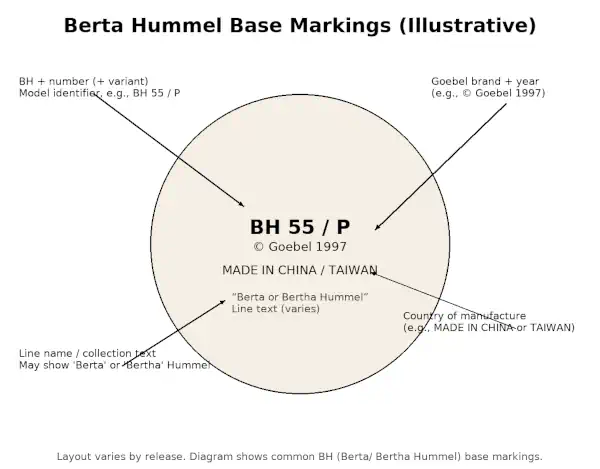
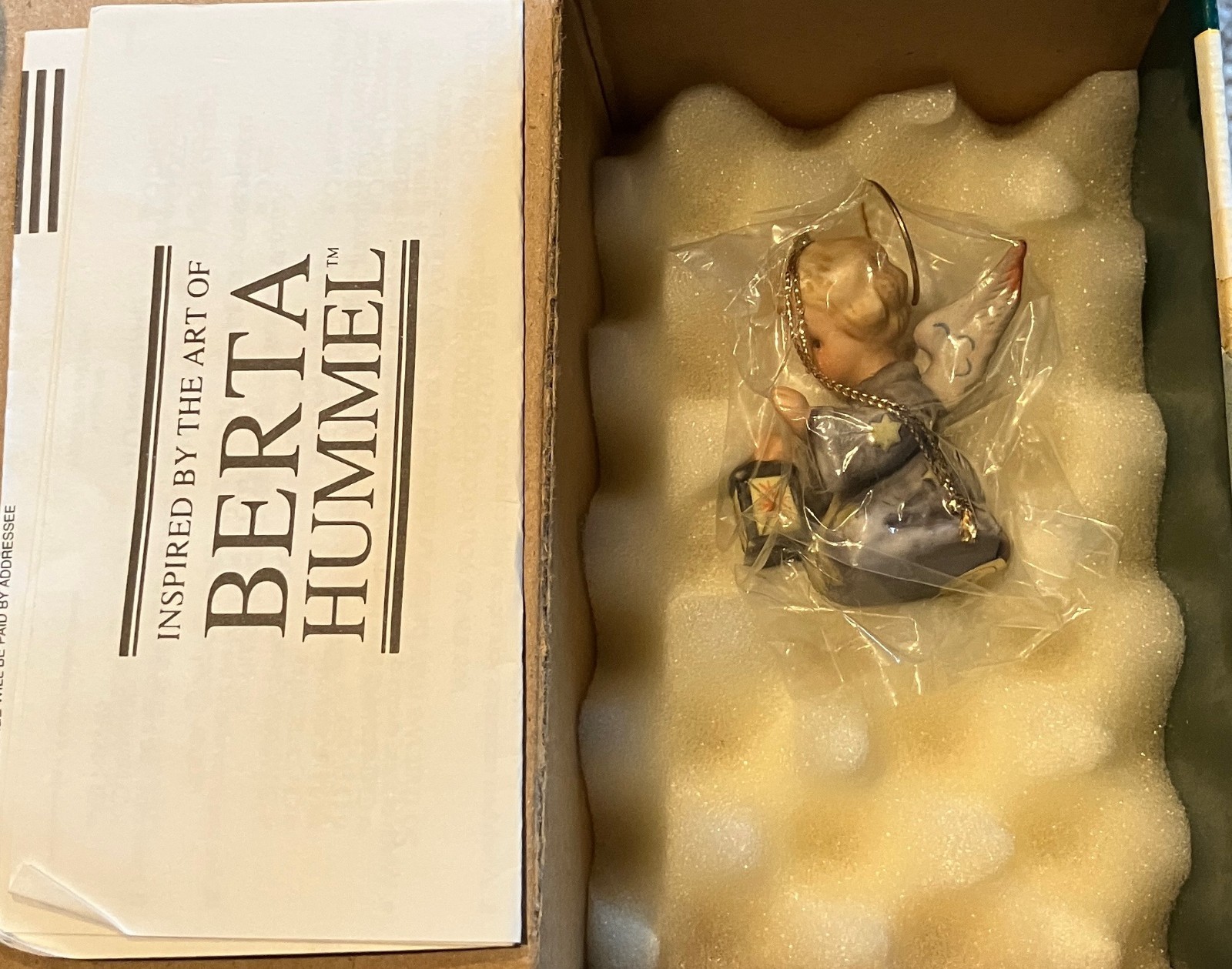
The original packaging tells you a great deal as well. Set boxes carry their set number along with Studio Hummel and Goebel branding, and many also show the Ashton-Drake name, since the collection was offered through Ashton-Drake Galleries. Check that the three ornaments in a boxed set actually belong together — mixed or swapped pieces do turn up, especially in larger lots that have changed hands more than once. The certificates of authenticity are a further confirmation, and a boxed set with all three COAs is about as well documented as these ornaments get.
Be wary of listings that describe an ornament as “Hummel style,” “Hummel-type,” or simply “Hummel” without any BH number or mention of the Berta Hummel name. Unlicensed look-alikes in the Hummel manner have been made for decades, and they can look charming in a photo while being something else entirely. It also helps to remember that these ornaments are a separate line from the authentic M.I. Hummel pieces made in Germany, which use an entirely different marking system of Goebel trademarks and model numbers. If you’d like to understand those marks as well, my guide on how to identify authentic Hummel figurines explains how to read them.
Berta Hummel Nativity Ornaments
Alongside the children’s ornaments, some pieces from the Berta Hummel nativity were also made in ornament form. They follow the same gentle style as the nativity figurines — angels, shepherds, and the Holy Family rendered in the soft, rosy-cheeked Hummel manner — but sized and finished to hang on the tree rather than stand in a crèche.
These nativity ornaments are identified by the same BH numbering as the nativity figurines, sometimes with an added letter. One example, a Standing Angel nativity ornament, is marked BH 26/D/O, and the final “O” appears to distinguish the ornament version from the figurine of the same design. Because I’ve seen that suffix on only a limited number of pieces, treat it as a helpful clue rather than a rule, and as always, ask the seller for a clear photo of the marking before you buy.
If you’re drawn to the nativity pieces, it’s worth knowing that the Berta Hummel nativity was also produced as a full set of figurines, sold as individual pieces and boxed groups with an optional wooden crèche. Those sets are a collecting world of their own, and my guide to Berta Hummel nativity sets covers what to look for, including how to make sure a set is truly complete.
Not to Be Confused With: Other “Hummel” Christmas Ornaments
Search for Hummel Christmas ornaments and you’ll quickly find several different lines that share the name, and they are easy to mix up in a listing. Knowing which one you’re looking at matters, because they differ in age, maker, and value. Here are the ones most often confused with the “A Berta Hummel Christmas” collection.
M.I. Hummel Christmas Ornaments
M.I. Hummel ornaments are made by Goebel in Germany from the artist’s later, convent-era work, and they carry the same marking system as M.I. Hummel figurines: a HUM model number and a Goebel trademark, or TMK, that changed over the decades. They include annual series such as the porcelain angel ornaments Goebel issued through the 1990s — Echoes of Joy, from 1998, is one example. These are a different line entirely from the Berta Hummel pieces, and if that’s what you have, my guide to understanding Hummel figurine values explains how the M.I. Hummel market works.
Schmid Berta Hummel Annual Ornaments (1970s–1990)
Long before Goebel’s Berta Hummel line, Schmid offered annual Christmas ornaments featuring Berta Hummel’s artwork, each one dated and issued as a limited edition. Many are round ball ornaments decorated with a Berta Hummel scene, and some are small hanging figures. Typical examples include “Christmas Child” from 1975, “Heavenly Trio” from 1978, and “Angelic Procession” from 1982. The year, the edition, and the Schmid name are usually printed on the ornament or its box, along with wording such as “by Sister Berta Hummel” or “Inspired by Berta Hummel,” which makes them easy to tell apart from the later Goebel sets.
Goebel’s Annual Berta Hummel Ornaments (2000–2006)
Goebel also produced a separate series of dated annual Berta Hummel ornaments between 2000 and 2006, apart from the boxed sets of three. These were figural ornaments issued one per year, and they are sometimes mixed into lots of “A Berta Hummel Christmas” ornaments. If an ornament carries a single year and was sold on its own rather than in a numbered set box, it may belong to this annual series instead.
Danbury Mint Hummel Gold Ornaments
In the 1980s, the Danbury Mint offered the Hummel Gold Christmas Ornament Collection, featuring Hummel designs on gold-finished ornaments. They look nothing like the porcelain Berta Hummel figures, but they turn up under the same “Hummel ornament” searches, so it’s worth knowing they’re a different product.
Unlicensed “Hummel-Style” Ornaments
Finally, many ornaments have been made over the years in the Hummel manner without any license at all. They’re often perfectly pleasant decorations, but they aren’t Berta Hummel or M.I. Hummel pieces, and they carry no BH number, no HUM number, and no Goebel or Schmid markings. When a listing leans on words like “Hummel style” or “Hummel type,” that’s usually the reason.
What Are Berta Hummel Christmas Ornaments Worth?
Most Berta Hummel Christmas ornaments sell for modest prices today, which is a large part of their appeal. As of fall 2026, single ornaments are typically listed on eBay for roughly ten to forty dollars, and boxed sets of three for around fifteen to twenty-five dollars, and boxed sets of three for around fifteen to twenty-five dollars. Large collections with the original storage box and certificates usually range from about sixty to two hundred dollars, while the rare new-old-stock collection in pristine boxes can be listed for more. Those figures are asking prices, though, not final sales, so treat them as a general picture rather than a price guide.
The most reliable way to learn what an ornament is actually worth is to look at what has sold, not what’s listed. On eBay, search for the design or set number, then filter the results by “Sold Items.” That shows you what buyers have actually paid recently, and it’s often noticeably lower than the asking prices on active listings. If you’re selling, it’s the best way to price realistically; if you’re buying, it tells you when a listing is fair and when it’s hopeful.
A few things consistently push value up. Original set boxes with their set numbers, all three certificates of authenticity, and clean condition with no chips or rubbed paint make the biggest difference. A collection still in its original storage box, especially one with a long, unbroken run of set numbers, will always draw more interest than the same ornaments sold loose. Ornaments that are unboxed, chipped, or missing their certificates still have their place on a tree, but they sell at the lower end of the range.
It’s also worth keeping expectations in proportion. Like the Berta Hummel figurines, these ornaments are best collected for the artwork and the pleasure they bring each December rather than as an investment. If you’re curious how the broader Hummel market has changed over the years, my guide to whether Hummel figurines are still valuable today puts it in context.
To show you the range in real listings, here are a few boxed sets and larger collections currently on eBay. Notice how much the box, the certificates, and the number of pieces affect the asking price — it’s the clearest illustration of everything above.


Where to Find Berta Hummel Christmas Ornaments
Because production ended in 2004, every Berta Hummel Christmas ornament available today comes through the secondary market, and eBay is where you’ll find the widest selection at any given time. Searching for “Berta Hummel Christmas ornament” will bring up plenty, but you’ll often find better results by searching the way sellers describe them: try “A Berta Hummel Christmas,” “Studio Hummel ornament,” or “Ashton-Drake Hummel ornament.” If you’re looking for something specific, search by the design name, the BH number, or the set number — “Set #8,” for example — to narrow the results to exactly what you need.
Timing makes a real difference with these ornaments. Listings tend to multiply in the weeks before the holidays, as families sort through decorations and decide what to pass on, so autumn is usually the best time to find a particular design or fill a gap in your sets. The flip side is that buyers are also more active then, so if you see a fairly priced piece you’ve been looking for, it’s worth not waiting too long.
Beyond eBay, estate sales and antique shops remain good hunting grounds, particularly in areas with strong German-American communities where Hummel collectibles were popular when these ornaments were first sold. Whole collections still turn up there, sometimes in their original storage boxes, and sellers don’t always know the difference between a Berta Hummel set and the more expensive M.I. Hummel pieces. Replacements, Ltd. also carries individual ornaments and boxed sets from the “A Berta Hummel Christmas” pattern, which can be a reliable way to find one specific missing piece. Hummel collector groups online are worth joining as well, both for buying and for learning which designs are proving harder to find.
If you’d rather start with a shortlist than sort through hundreds of listings, my curated collection of Berta Hummel Christmas ornaments gathers listings that show clear photos of the ornaments and their markings, so you can compare pieces at a glance. Here are a few from the current selection, including nativity pieces alongside the children’s designs.


Storing and Caring for Your Ornaments
Berta Hummel Christmas ornaments are small and fairly sturdy, but they spend most of the year packed away and a few weeks each December being handled, which is when most damage happens. The best protection is simply the way they were originally kept: each ornament in its own set box, with the boxes stored together in a sturdy container, or in the original collection storage box if you have one. That keeps pieces from knocking against each other and keeps the certificates with the ornaments they belong to.
When it’s time to put them away, make sure each ornament is completely dry and dust-free, and wrap any loose pieces individually in colorless foam or bubble wrap before boxing them — never newspaper, whose ink can transfer onto the paint. Store them somewhere with a steady temperature and low humidity — a closet inside the house is far kinder to porcelain and paint than an attic or garage, where heat and cold swing from season to season.
On the tree, hang them from sturdy branches using the original hanger or a secure ornament hook, and keep them out of reach of small children and curious pets, since a fall onto a hard floor is the most common way these ornaments chip. For cleaning, a soft dry brush or cloth is usually all they need; avoid water, sprays, and chemical cleaners, which can dull the finish or lift the paint. The same principles apply to all porcelain Hummel pieces, and my guide on how to care for Hummel figurines covers cleaning, handling, and storage in more detail.
If You Love German Christmas Ornaments, There’s More to Explore
Berta Hummel ornaments are part of a much longer German tradition of decorating the tree with pieces meant to be kept and handed down. If that tradition speaks to you, the handmade wooden ornaments of Germany’s Erzgebirge region carry it on today — carved and painted by hand in small workshops, from makers like Christian Ulbricht and Richard Glässer. You can browse our authentic German Christmas ornaments, or read my guide to the top German Christmas tree ornaments to learn about the styles and workshops worth knowing.
Berta Hummel Christmas Ornaments FAQ
What are Berta Hummel Christmas ornaments?
Berta Hummel Christmas ornaments are small porcelain ornaments produced by Goebel from 1997 to 2004 under the collection name “A Berta Hummel Christmas.” Each shows a child in a seasonal scene based on Berta Hummel’s pre-convent artwork, and they were sold in numbered boxed sets of three, with a certificate of authenticity for each ornament.
When were Berta Hummel ornaments made?
The “A Berta Hummel Christmas” boxed sets were made from 1997 to 2004. Goebel also produced a separate series of dated annual Berta Hummel ornaments from 2000 to 2006, and much earlier, Schmid issued annual Berta Hummel Christmas ornaments from the 1970s through 1990.
How many Berta Hummel Christmas ornaments are in a complete set?
There’s no single number. Collections of 36 ornaments, twelve boxed sets of three, are common and often described as complete, but the set numbering continued well past twelve, and larger collections of 45 or more pieces also turn up. When buying a “complete” collection, ask which set numbers are included and how many pieces there are.
Are Berta Hummel Christmas ornaments valuable?
Most are modestly priced. As of fall 2026, single ornaments are typically listed for about ten to forty dollars, boxed sets of three for fifteen to twenty-five, and large collections with the storage box for roughly sixty to two hundred dollars. Original boxes, certificates, and good condition add the most value, and eBay’s “Sold Items” filter shows what buyers are actually paying.
How can I tell if a Berta Hummel ornament is authentic?
Check for the BH number that matches the design, the original numbered set box with Studio Hummel and Goebel branding, and the certificate of authenticity. When buying online, ask for a clear photo of the marking, and be cautious of listings described only as “Hummel style” without a BH number.
Are Berta Hummel ornaments the same as M.I. Hummel ornaments?
No. M.I. Hummel ornaments are made by Goebel in Germany from the artist’s later, convent-era work and carry HUM numbers and Goebel trademark marks. Berta Hummel ornaments are a separate line based on her earlier artwork, identified by BH numbers.


